Why go on a roadtrip in Spain?
Do you have 1 week, 10 days, 15 days or even 1 month of holidays? Now’s the time to opt for a roadtrip to discover …
- Discover as many things as possible
- Satisfy your thirst for adventure and freedom by hitting the open road!
Choosing your route
In Spain, the choice is vast: 505,990 km² and a huge number of roads to cover! Here are just a few examples (and there are many more) of roadtrips you can enjoy:

Roadtrip in Andalusia: a sunny cultural trip
With a mild climate all year round, Andalusia is ideal for a short roadtrip lasting a few days or even weeks. Take the time to explore the region and its emblematic cities, and soak up the Andalusian culture.
Seville, Cordoba, Granada, Malaga and Benalmadena, Ronda, Cadiz. You can also plan to visit some of Andalusia’s white villages. These can be visited in 1 to 2 hours each, so you can see several in the same day! My favourites: Zahara de la Sierra, Arcos de la Frontera and Ronda.
In Andalusia, beware of the towns and villages, which are not very accessible by car and even less so by van. I would advise you to park outside if you choose one of these options.
If you’re not a fan of crowds, avoid Holy Week.
Roadtrip in Andalusia: a sunny cultural trip
Galicia, Asturias and Cantabria are the key regions for organising a van roadtrip! A mix of Brittany and Scotland with an Australian lifestyle: vanlife and surfing. You don’t have to be a surfer, of course, or necessarily travel by van, but the West coast from Galicia to the Basque Country is well worth an extended visit: breathtaking landscapes between land and sea, a very wild coastline (which is becoming rare in the Mediterranean, for example), this is paradise for nature lovers.
In Galicia, if you want to do several “capes” one after the other, you’ll need to factor in the journey times. This can quickly take several hours. Note also that the weather is a little more capricious than in the South, with more rain.
Roadtrip in Northern Spain: From the Mediterranean Sea to the Spanish Pyrenees
From Catalonia to Aragon, passing through two of the country’s most beautiful hiking areas. How does that sound? This roadtrip is perfect for thrill-seekers in search of sensational scenery.
Beware that winter arrives early in the Pyrenees with snow and cold! The roads can sometimes be difficult to negotiate, so it’s best to be informed beforehand!
And on the islands?
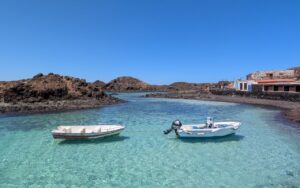
Travelling to an island sounds like a dream, doesn’t it? Why not plan a little roadtrip to the Canaries. Car rental is cheap, the weather is good all year round (I’d recommend going out of season, even in November when temperatures are around 25 degrees and you’ll be fine) and you’ll be able to enjoy some unusual volcanic landscapes!
Choice of transport and accommodation
If you want to get in on the van life trend, rent a converted van! This means of transport has developed rapidly in recent years, and even more so this summer! And it’s true that it offers a number of advantages: you can sleep wherever you like (or almost wherever you like), wake up in the middle of the countryside to magnificent scenery, and be free of holiday schedules and rhythms.
You can rent a van via Yescapa (a private rental service). This is the option we chose for our September roadtrip in Galicia and Asturias, and we’re very happy with the service! There were a few vans available in Valencia, so we were able to talk easily with the owners. It was very practical!
Renting is a little expensive, but you do need to take into account that you have accommodation and means of transport included.
To find a place to sleep, there’s an app: Park4night. Tip: read the most recent comments to make sure you can spend the night and/or park in peace.


You also need to think about parking (as you do for your van), especially if you’re travelling through towns.
By public transport, which is ideal if you prefer to travel through the cities: by train (the Spanish rail company is Renfe, but you can also find information via SNCF Connect) or by bus, which is a very economical solution but takes a little longer.
For the more sporty (and determined): on foot or by bike? After all, Spain is the country of the Santiago de Compostela pilgrimage!
The choice of activities
Once you’ve decided where you’re going and how you’re going to get there, it’s time to find out what you can do, what you can see and what you can’t miss in the region. This is one of my favourite parts: I spend hours on Pinterest, blogs, travellers’ forums, Instagram #s and in books listing all the things to do that, above all, interest me. Place them on the map of your itinerary and see how the two fit together, but above all don’t permanently delete from your list the things you won’t be able to do or see (you might go back, don’t you? )
Please book in advance for activities and visits.
You can also find out about the region’s culture, cuisine, etc.
Having your itinerary mapped out and the activities you can do at each destination will give you an initial idea of how much time you’ll need to spend there.
A few tips
- Don’t plan too many activities per day and don’t forget to include rest periods.
- It’s sometimes difficult to estimate exactly how many days you’ll need for each step. I advise you to identify a few key moments in the trip around which you can build the rest of the itinerary. For example, on our trip to Galicia and Asturias, we had 10 days planned: 1 day for the outward journey to Asturias and 1 day for the return journey to Valencia. On day 5, we had to be in Galicia and on day 7 we had to be in the Parada de Sil.
- Take your own pace into account. While some people prefer to stay in one place for 2 or 3 days, others will want to move around every day.
- You should also determine in advance the average number of kilometres you wish to cover per day.
- Don’t pack too many bags and suitcases: even if you’re travelling from hotel to hotel, remember that you’ll often have to re-pack!
- Leave a little room for improvisation.
You can also read: Tips and tricks for your trip to Spain